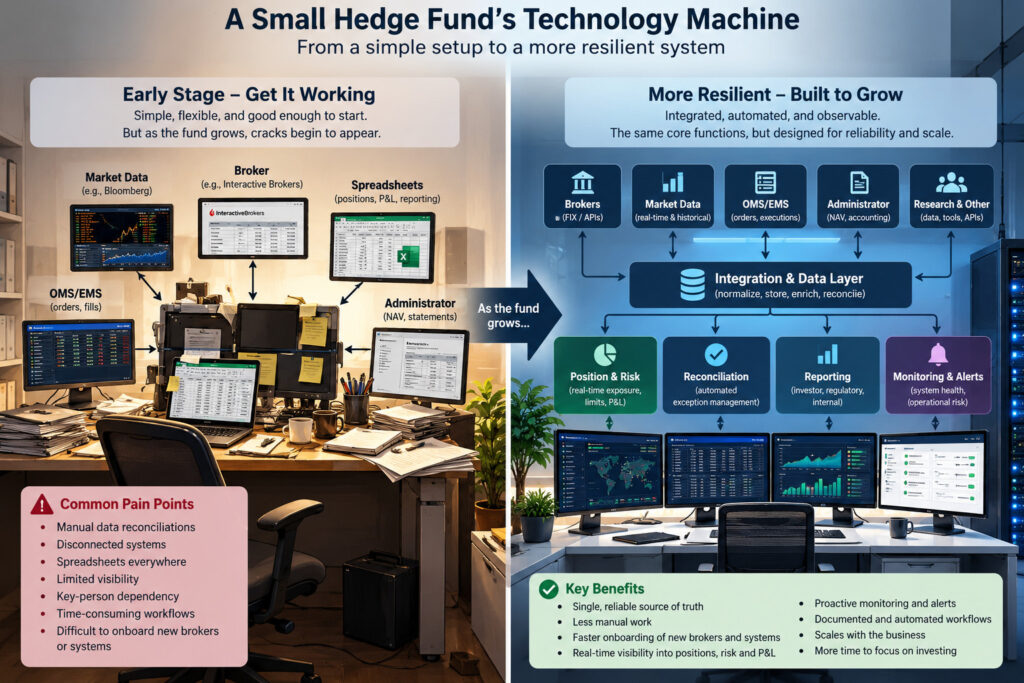
The fund is growing. The technology that got you here is starting to struggle. Have any of these happened to you:
- You take on a new broker and discover your existing systems aren’t prepared for it.
- The reconciliation that has worked flawlessly for years suddenly produces an abnormal result – right when account statements need to go out.
- The spreadsheets that once worked perfectly now take hours to maintain, and you’re not sure what should replace them
Take a step back
In the rush to launch a fund, you build the machine you need to get moving. And that’s the right thing to do. You don’t need enterprise infrastructure on day one. You need something that works. The problem is that the machine doesn’t always grow at the same pace as the business.
Hindsight says to investigate the problem and take remedial steps to prevent its reoccurrence. But when you are busy with so many different and important tasks, the investigation gets delayed or never happens.
You may find yourself spending time fighting back-office fires instead of being focused on generating revenue.
Step 1 – Put out the fire
In the heat of battle, you must focus your attention on what counts. Get the machine working again. Save any logs, take any notes. Promise yourself you will get to the issue promptly.
Step 2 – Investigate
Attempt to determine the likely cause. Exactly how to do this depends on the system, but it often involves following the chain of events start-to-finish or in reverse. Again, notes can be key here, as they can lead to pattern recognition.
Step 3 – Fix the underlying problem
When the culprit is found, find the best way to clean up the mess. It may be beneficial to establish policies so that if it happens 6 months from now, you know where to start, what to look for, how to get things running again, and how to make sure everything is accounted for.
Step 4 – Prevent
Adding resiliency to a running engine is not easy. It requires an investment in time, resources, and energy. Sizable firms invest large sums in enterprise-wide software packages and a staff to customize them in order to keep systems moving forward.
A $50 million fund doesn’t need the technology department of a $10 billion fund. But it does need the principles that make larger organizations resilient: visibility, documented processes, redundancy, monitoring, and clear ownership. The difference is scale.
Small funds don’t need big-fund technology. They need big-fund thinking applied at the appropriate scale
Putting out the fire isn’t the same as fixing the system
It is a bit unfortunate that when the issue is finally resolved, the celebration is usually short-lived. Everyone gets back to work. With the appropriate solution in place, the problem is soon forgotten. There’s always another deadline, another trade, another investor request, another operational problem. A new fire soon appears and the cycle begins anew.
You can’t simply ask, “What problems don’t I know about?” Unknown problems are, by definition, difficult to identify. Finding them requires adversarial thinking: looking at systems from the perspective of how they could fail instead of how they are supposed to work. Even then, things are easily missed.
But we should not show up without tools.
- Audit – Periodically examine your technology, workflows and data flows with the goal of finding weaknesses before they become operational problems. A good audit should result in a prioritized roadmap. A 100 page report that sits on a shelf serves no one.
- Telemetry – A problem is best caught early in the process. Give your systems a way to tell you what’s happening. Logs, metrics and alerts can reveal abnormal behavior before someone notices a failure. Modern monitoring tools can turn this information into dashboards that make the health of your infrastructure visible.
- Workflow automation – Procedures that work when three people are involved can break down when your staff grows to 10. As a fund grows, important processes need to become repeatable, assignable, and visible. Workflow software can turn informational procedures into processes with clear ownership, deadlines and exception handling.
Fire prevention is an expense. So is fighting fires. For a small fund, the challenge is deciding where prevention is worth the investment. You don’t need to build an institutional technology department. But you do need to recognize when the technology that got you here is no longer appropriate for where you’re going. The goal isn’t perfect infrastructure. It’s infrastructure that is appropriate for the size and complexity of your fund – and that can grow with it.
I help emerging managers and small hedge funds identify and solve these kinds of technology and operational problems. If something in this article sounds familiar, I’m happy to have a no-obligation conversation about what you’re dealing with
I’m also always interested in connecting with professionals who provide complementary services to emerging managers and small funds.